



WINNING OVER HER INJURIES TO GET TO BIRDY’S BACKYARD
Contributed by Nancy Williams, AURA member
BIRDY’S BACKYARD ULTRA, TOWERINNING (WA), 5-7 August 2022
It’s a tough proposition when you enter a race which has seen an Australian record set on the same course. It’s even tougher when both of the Australian record holders at that time – male and female – are entered as well. But as ultra runners, we love a challenge and Birdy’s Backyard Ultra in WA certainly was that.
I had fallen in love with the race format at the Hysterical Carnage Backyard Ultra in SA in November 2021. I had come out of that race eager for the next one and I had thrown myself back into training almost immediately. Things were going well, until they weren’t.
At the end of January I got the news that no runner ever wants to hear. Pre-stress fracture, de-load immediately, in a moon boot for a minimum of three weeks. I had entered Herdy’s Frontyard Ultra in March so I was devastated. I knew I was never going to be ready for it. It was agonising to accept, but my return to the ‘loopy loop’ format (as we affectionately call it) was going to be delayed for a while at least.
Over the following months my recovery and training was slow and intermittent. Further injuries resulted after I ran a 120km in May and there were times I wondered whether I was even going to make it to Birdy’s. I know my coach suggested (subtly of course) that a couple more months of recovery and training might help.
But I didn’t have a couple more months. Birdy’s was coming up and I wasn’t going to miss it. The lead up to it, the planning, the strategising, the dodging of covid…we got through all of it and arrived at the airport on the Thursday before the race, ready to run. If there was one thing I knew about this race format, at least for me, is that I cannot do it without a crew who I literally trust with my life. This is why my best friend, Beth, was there at the airport with me, as much a part of the race as I was.
We arrived at Lake Towerrinning with the sun shining despite the cold air. Things were happening already. The race village was almost set up, people were there putting up gazebos and tents and there was a buzz of excitement everywhere. We found Shaun and got our obligatory hug. No race run by Shaun Kaesler can begin without that fabulous, all encompassing hug. We pitched in to set up, then got ourselves into bed by 6.30pm (we were still on SA time) to try to get as good a sleep as possible before it began.
Race day. The sun was out. Our aid point was set up. My bib, number 434, was pinned on. Once the race briefing was done, all of us – some 100 runners – lined up in the corral unsure of just how many times we’d be doing this in the hours to come. And then, the gun sounded and we were off…
My coach had warned me that that first lap would be too fast, but not to worry as it was inevitably being pushed by adrenaline and excitement. He was right. Although I chatted pretty much the entire lap, I still finished in around 43 minutes. It felt wrong to be sitting down at the end, but with a plan in place, I followed it right from the outset. In the next few laps, I set my routine. It took a while as there were so many great runners out there to chat to, I couldn’t miss the socialising. This is half the fun of this format. Because most people aren’t racing to speed, almost everyone is willing to have a chat – at least for the first laps. There’s no doubt that as the hours ticked by and the field started to thin out, things got quieter and quieter out there. But there was a carnival atmosphere while the sun shone on that first day.
By around lap 5 I had my routine in place. I like to name things as they provide me with reference points each lap. Anyone who has run the Birdy’s loop will probably recognise what I am talking about when I say we crossed the ‘Moonscape’, jumped over ‘Tin River’ and then headed towards the ‘Mine Field’. But I also named all of the skulls. Every lap I silently acknowledged Boris, Cedric, Adele and Franklin. And of course, Neville, the human skull (plastic, of course). You can imagine how creeped out I was when Neville, who had been under a wheel in the caravan graveyard for hours, suddenly disappeared in the night. It was only the next morning with the daylight that I realised Neville had been moved to the USWA arrow further along the course.
As the sun went down, the feelings of ‘yeah, I can do this forever’ started to wane, replaced by ‘I’m starting to hurt. Maybe I can’t do this forever’. Darkness seemed to come early and with it being winter I knew there were almost 12 hours of it ahead. The first few hours of darkness aren’t too bad. You get used to running with the headlamp, and there are still plenty of people around. But the night crawled on and the darkness seemed to go on forever. At around 3.00am, just as I was about to head out on the 18th lap, Beth put her arm around my shoulder and reminded me that this was the darkest and hardest time. I just had to get through to dawn and it would be OK. She was right, but they were three long, hard loops which pushed my mind to some very difficult places.
Dawn was spectacular. The sky burned red as the sun began to rise. I had a coffee, and with the burst of light and even bigger burst of caffeine, I could feel myself lift. I had run 25 laps at Hysterical, timing out on 26. Every time that little voice in my head said ‘you can’t do this’ I’d mentally smack it back down saying ‘yeah, you can. You’ve done it before and you know you can go further’. I felt like my pace was slowing, but the clock said it wasn’t. I was still coming in consistently between 48 and 51 minutes per lap, every lap. While I was doing that, I was going to keep going.
24 hours. 100 miles. There were 16 of us left. Two other incredibly strong women – Jen Millum, who seemed to go on and on without tiring, and the Australian women’s record holder, Jessica Smith – were still in the field. Both of them were nothing but an inspiration to me. I’d watch Jess with the group of runners who ran with her each lap, and give myself words of encouragement by reminding myself I was still hanging in there with the elites. She was amazing to watch. As were all of the others going lap after lap. In particular, the beautiful soul who is Kevin Matthews. Each lap, I started out slower and slower, accepting I’d be DFL and that was OK. But as I rounded the bend to enter the caravan graveyard, Kev, who was just leaving the graveyard would look over at me and give me a smile and a wave. Once I’d seen that and waved back, I knew I could keep going.
Lap 25, then 26, then 27 passed. However, deep down I knew I was headed for trouble. I had struggled to get solid food in from around lap 16. We’d had to madly adjust my plan to try to make up the calories and carbohydrate in liquid form. But I think I knew that not enough was going in. I kept forgetting to drink as well, crossing the finish line each time in those later laps with an almost full bottle. My legs were aching, my hips were aching, but without the nutritional energy, things were getting hard.
On lap 29, I was really struggling to keep up my shuffle. I started pace watching – always a danger for me as I can get obsessive about it – and I could see it dropping. Although I felt like I had slowed significantly, the clock told me I still finished in 51 minutes. I think I got some food down, but that 9 minutes passed in an instant and I was back on the start line again. My Garmin had died just as I’d finished the 29th lap, so Peta, my other crew member, threw her watch on my wrist because I was afraid that if I didn’t have some way to measure my pace, I might not make it in on time. But I was going to finish lap 30. I was not going to time out. I shuffled out but there was so little in the tank, it was only will that got me there.
I did make it around on lap 30, finishing in just over 56 minutes. My crew gave me a gel, but halfway through I could feel my stomach lurch and I just couldn’t take any more. Kev gave words of encouragement, the seconds ticked down and I was out on lap 31. But 150 metres down the track, my stomach gave way and I stopped, dry retching against a tree. Suddenly, 6.71km felt like 671km. I mentally called it, turned around, and limped back to the start, stopping every few moments while my stomach convulsed, but by some miracle, still smiling and laughing through the pain.
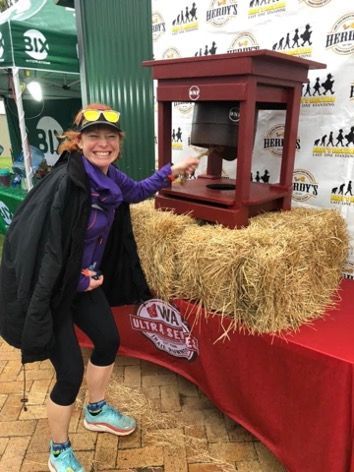
Ringing that bell was one of my proudest moments. Not only had I beaten my own PB by 5 laps, but I’d reset the SA women’s record. I’d come into the race having dealt with injuries and some serious personal challenges. I knew I wasn’t at peak fitness but I still got myself out and ran over 200km. But best of all, I had learnt so much. I had watched others, I had tried things out. Between me and my crew we’d seen what worked and what didn’t. We had taken notes. I was already thinking about where I could improve. But isn’t that what we do every race? There is no such thing as a perfect race. If there was, we’d never get better. I take lessons out of every race experience so I can implement them in the next. This time, 30 laps. Next time, who knows? The one thing I do know is already, while the muscles still ache, I am planning, strategising and getting excited for the next one. The loopy loop adventures have only just begun.
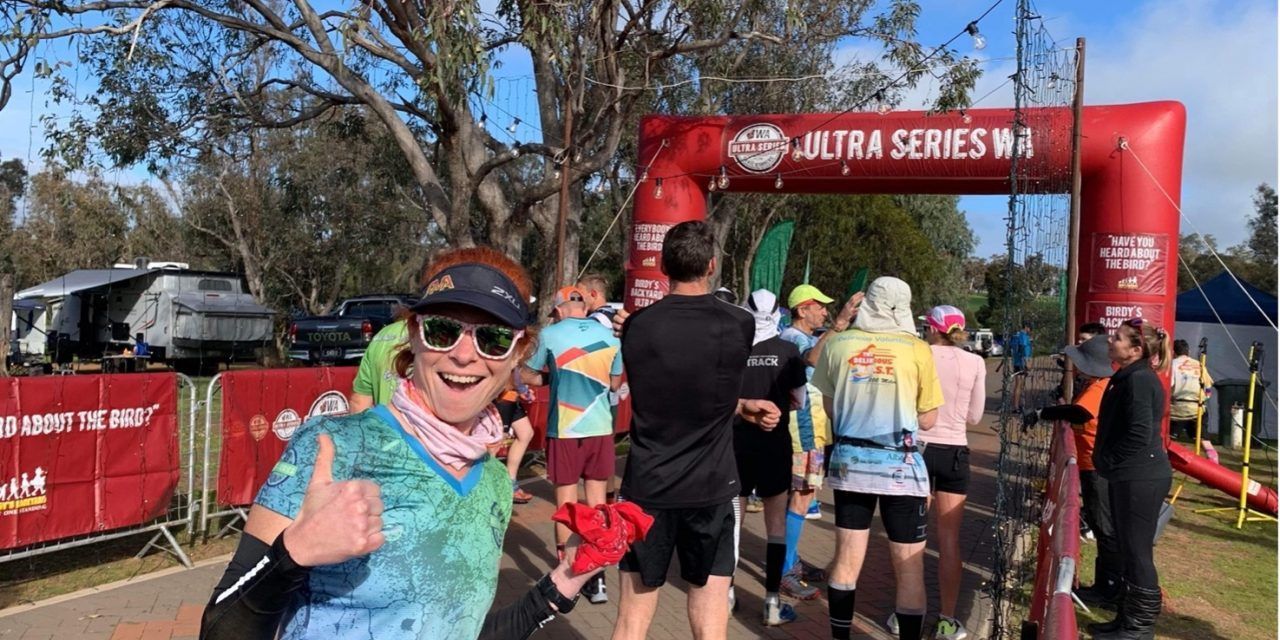
Featured: Nancy Williams being enthusiastic at the very start of Birdy’s Backyard. Photograph – Supplied.
share this
IN OTHER NEWS
